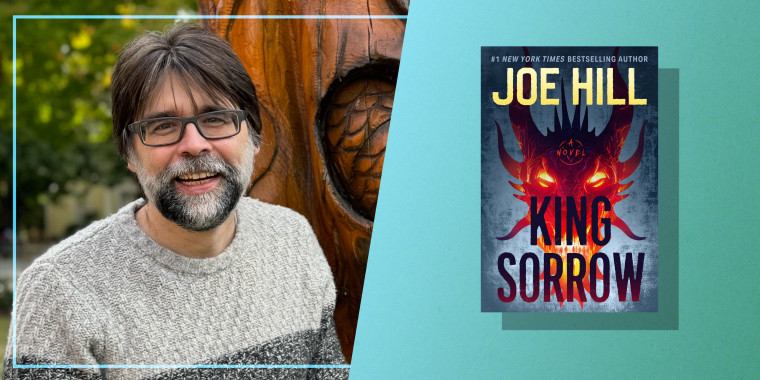
My reading experience with Joe Hill’s King Sorrow:
When I started reading King Sorrow, I knew I had something big on my hands. Literally—the book is almost 900 pages long. But what immediately struck me was how Joe Hill manages to slowly but surely draw you into his world. It’s not a book you read in one sitting, but rather one that draws you in, chapter after chapter.
The story begins in the 1980s in Maine, with a group of students performing a ritual that summons a dragon: King Sorrow. That may sound like pure fantasy, but Hill manages to anchor it in a raw, realistic setting. The atmosphere is dark, mysterious, and sometimes downright oppressive. You sense that something is wrong long before it actually goes wrong.
 At first, I thought Arthur Oakes was the central character. His confrontation with Jayne Nightswander and her boyfriend and the choices he makes set everything in motion. But as the story progresses, my view of him began to shift. He remains important, but by the end, I realized that Gwen is actually the true protagonist. Despite everything she goes through—her traumas, her struggles—she is the one who finds the strength to confront and defeat King Sorrow. I found that to be one of the most delightful surprises of the book: how the focus subtly shifts and how Gwen, without much fanfare, becomes the moral and emotional heart of the story.
It doesn’t start slow, or is difficult to keep going back like other long books. And as soon as Dragony ‘o Clock approaches, I could hardly put the book down. The tension sometimes is so intense that as a reader you are drawn into the threat and the mystery, and you just have to finish that chapter!
What I also found powerful is how Hill returns to each character and their personal experience of King Sorrow’s summoning at later points in the book. This not only adds depth, but also shows how each of them has grown — or, conversely, become stuck — in their lives. You gain insight into their choices, their fears, and how that one moment shaped them forever.
One aspect that particularly struck me was how King Sorrow is not only an entity that demands sacrifices, but also a force that — if approached cleverly enough — can be used for personal gain. One of the characters turns out to do just that: not out of fear, but out of ambition. This adds an extra layer to the story. It makes the dragon not only a monster, but also a mirror of human desires. It raises questions about power, manipulation, and how far someone is willing to go to achieve their goals. I found that to be one of the most disturbing and, at the same time, fascinating elements of the book.
What makes King Sorrow truly special to me is how rich and multifaceted it is. It really has everything: trolls that appear in unexpected forms, a shadowy black ops organization operating behind the scenes, and a world that is becoming increasingly intertwined with our own. As the years progress in the story, you notice that more and more elements from the real world are popping up. The book cleverly plays with historical and social events and weaves them into the fictional story, making it feel even more believable and oppressive.
Compared to Hill’s earlier work:
As a fan of Joe Hill, I have enjoyed reading his earlier books, and NOS4a2 was one of my favorite for a long time. That novel had a strong antagonist, an original world (Christmasland!), and a main character with a special gift. But where NOS4a2 excelled in suspense and world-building, King Sorrow goes deeper. It is more layered, more emotional, and thematically richer. Hill seems to pull out all the stops here: from character development to moral dilemmas, from horror to tragedy.
For me, King Sorrow is his best work to date. It feels as if he has used his full writing power in this book — as if everything he has written before comes together here in a mature, compelling, and unforgettable story.
In summary:
King Sorrow is not light reading, but it is a book that makes an impression. If you like stories that challenge you, that play with time and morality, and that make you think about what people are willing to do to protect their friends — then this is one to read. And for me, it was Gwen who ultimately gave the story its soul. But it is also King Sorrow itself that forces you to think: about what you would do if you could gain power, and what you are willing to give in exchange. And if you pay close attention, you will see that the world of the book sometimes begins to resemble our own.
—Ben, october 2025